A History of Timeless Belcher
History
Charbelcher has been a Legacy and Vintage staple for over two decades. The deck's gameplan is simple: assemble enough mana to cast and activate Goblin Charbelcher, revealing your land-less library for lethal damage to opponent. Traditionally built around red for its ritual acceleration and blue for cantrips and card selection, Belcher has always sat at the intersection of raw speed and tight construction.
A Perennial Format Bystander
Belcher has existed on the fringes of MTGA non-rotating formats for a long time — always potent, never quite mainstream. However, the proliferation of Modal Double-Faced Cards (MDFCs) in recent years has changed the calculus dramatically. Because MDFCs are spells in the library rather than lands, decks can run zero land cards while still maintaining the mana flexibility they need to operate. Spells like Shatterskull Smashing, Silundi Vision, and Bala Ged Recovery function as land drops when needed but count as spells for Charbelcher's purposes. This development has made Belcher viable in two-color and even three-color configurations that were previously impractical, opening up a wave of new brews across Timeless.
The History
The earliest Timeless Belcher lists naturally gravitated toward Izzet, mirroring the deck's Legacy roots. Fast mana wasn't so readily available in those days, but the original lists were able to find some things that worked via Treasure synergy. Strike it Rich, Prismari Command, and discarding Creative Outburst were some of the ways we got it done. Put this together with blue cantrips and we were able to pretty reasonably ramp and find our combo pieces. The MDFC suite of Spikefield Hazard, Shatterskull Smashing, and Silundi Vision provided land-like flexibility without counting as basic lands, making Charbelcher a reliable lethal hit.
While Izzet was consistent and well-understood, it lacked the raw power ceiling that more degenerate mana engines could provide, leaving the door open for further experimentation. In a format that was constantly trending toward turn 2-4 wins, it was never the powerhouse it felt like it could be.
The Brews
Distinct belcher variants have emerged as players have looked for the next tier 1 belcher variant. Some have shown high upsides, but speed and consistency have been hard to find in plentiful enough amounts.
A Mono-Black Sacrifice Belcher leaned on Dark Ritual as well as Sacrifice-ing a Grief or other useful black creature to generate mana surges, that could sometimes fuel a Charbelcher cast and activation in a single turn. Some riskier decks used Scourge of the Skyclaves to lean into the mana-producing side of things. However, expensive mono black tutors played at odds with the Charbelcher mana requirements, and topdecking with this deck always felt weak.
Some Mono-Red Belcher lists doubled down on red rituals - Irencrag Feat and the aforementioned treasure package solved the mana issue, and impulse draw got you card advantage. However, problems would often arise as the treasure package requires card advantage and impulse draw is somewhat of a lacking way to provide it.
One of the more promising Belcher variants was a Mono-Green variant, using a high density of mana dorks paired with the mana-doubling Leyline of Abundance. With the right hand, this deck could support a combo win or a combat win, but of course folded hard to board clears or due to lack of card draw. Summoning sickness made is so this deck was slower than its red counterpart, which ultimately made it harder to believe in.
After Timeless got the pitch elementals of Fury and Grief, the Rakdos Scam archetype washed over the legal MTGA formats. We received a pretty compact tempo-control shell that could actually hang in the mid-game, and present a potent creature threat on turn 1 with effects like Reanimate and Not Dead After All. Slotting midrange-compatible card draw like Fable of the Mirror-Breaker in gave the deck a much more resilient feel. The only issue is that Charbelcher wasn't really needed in this shell - it would sometimes feel as though Belcher was the secondary plan.
Where We're At
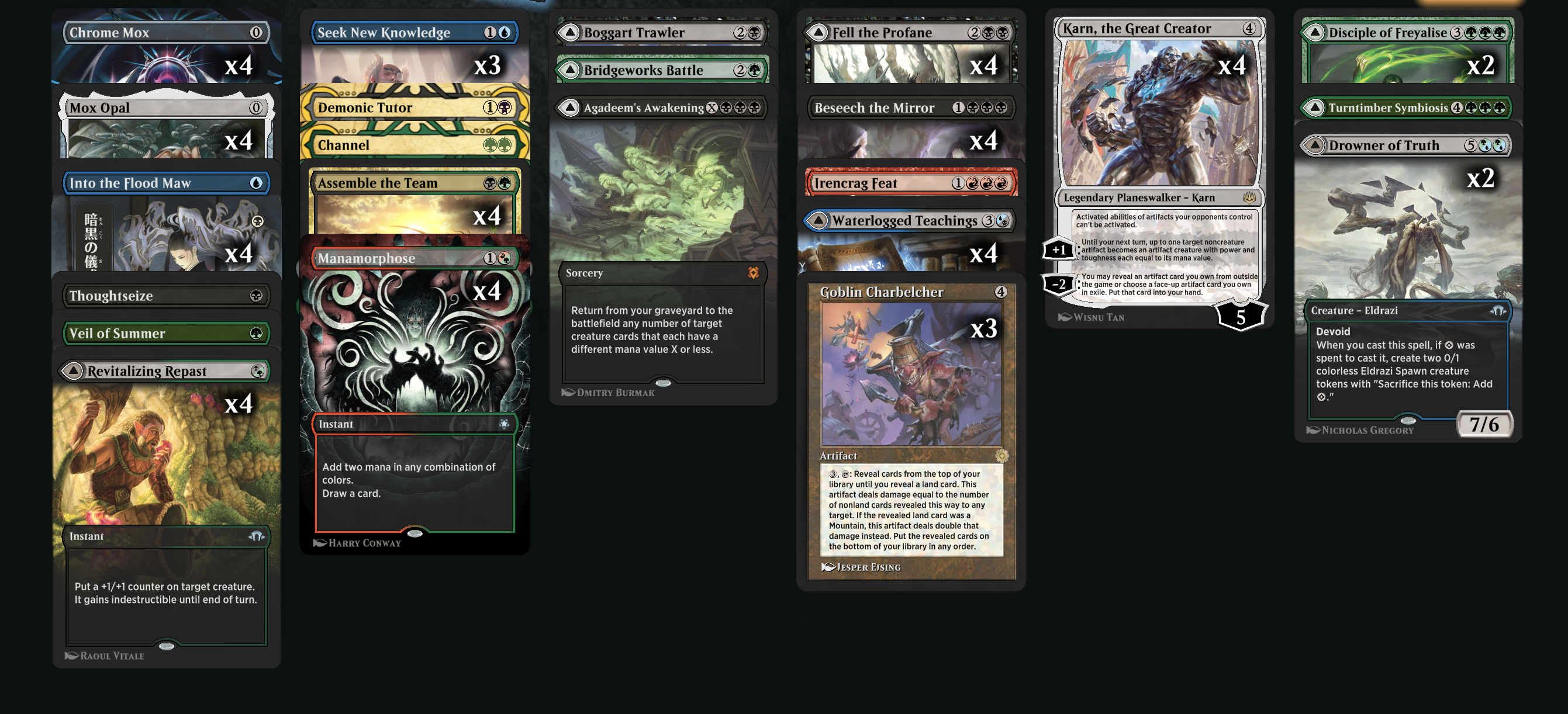
I've found a decent level of success refining Sultai Belcher, a build that trades some raw speed for an overwhelming density of tutors in Demonic Tutor and Assemble the Team. These colors have access to mana with Dark Ritual, Channel, and artifact mana from Chrome Mox and Mox Opal, which incedentally works great with Beseech the Mirror. Recent printings of Manamorphose into Arena have continued to smooth the gamplan out. Finally, we get to maintain our Veil of Summer protection.
The Karn, the Great Creator package turns the deck into a toolbox: Karn can fetch Charbelcher directly from the sideboard while simultaneously locking opponents out with access to Liquimetal Coating. A single copy of Channel serves as a one-card kill condition with a Karn in hand, provided you have the 11 life to make it happen.
Sultai Belcher sits as a pretty competitive entity in the Timeless format — a convergence of Legacy-style mana abuse, MDFC innovation, and Arena's unique card pool. If you are looking for a deck that rewards tight sequencing and punishes fair strategies from the very first turn, this is a great place to start.